Evidence that Jesus is God

John 10

22It was now winter, and Jesus was in Jerusalem at the time of Hanukkah. 23He was at the Temple, walking through the section known as Solomon’s Colonnade. 24The Jewish leaders surrounded him and asked, “How long are you going to keep us in suspense? If you are the Messiah, tell us plainly.”

25Jesus replied, “I have already told you, and you don’t believe me. The proof is what I do in the name of my Father. 26But you don’t believe me because you are not part of my flock. 27My sheep recognize my voice; I know them, and they follow me. 28I give them eternal life, and they will never perish. No one will snatch them away from me, 29for my Father has given them to me, and he is more powerful than anyone else. So no one can take them from me. 30The Father and I are one.”

31Once again the Jewish leaders picked up stones to kill him. 32Jesus said, “At my Father’s direction I have done many things to help the people. For which one of these good deeds are you killing me?”

33They replied, “Not for any good work, but for blasphemy, because you, a mere man, have made yourself God.” (John 10:22-33, NLT)

Acts 14

8While they were at Lystra, Paul and Barnabas came upon a man with crippled feet. He had been that way from birth, so he had never walked. 9He was listening as Paul preached, and Paul noticed him and realized he had faith to be healed. 10So Paul called to him in a loud voice, “Stand up!” And the man jumped to his feet and started walking.

11When the listening crowd saw what Paul had done, they shouted in their local dialect, “These men are gods in human bodies!” 12They decided that Barnabas was the Greek god Zeus and that Paul, because he was the chief speaker, was Hermes. 13The temple of Zeus was located on the outskirts of the city. The priest of the temple and the crowd brought oxen and wreaths of flowers, and they prepared to sacrifice to the apostles at the city gates.

14But when Barnabas and Paul heard what was happening, they tore their clothing in dismay and ran out among the people, shouting, 15“Friends, why are you doing this? We are merely human beings like yourselves! We have come to bring you the Good News that you should turn from these worthless things to the living God, who made heaven and earth, the sea, and everything in them. 16In earlier days he permitted all the nations to go their own ways, 17but he never left himself without a witness. There were always his reminders, such as sending you rain and good crops and giving you food and joyful hearts.” 18But even so, Paul and Barnabas could scarcely restrain the people from sacrificing to them.

(Acts 14:8-18, NLT)


The Daily DAVEotional

A number of years ago, I had some conversations with two Jehovah’s Witnesses who came to my door seeking to proselytize me. I wrote about that encounter in a previous post here.

The Jehovah’s Witnesses are a religious group that has its roots in Christianity but is not Christian in their theology. That’s because they deny both the traditional Christian doctrine of the trinity, which they believe is rooted in paganism, and the doctrine of the divinity of Christ, which they assert was not the belief of the early church but was introduced as a false doctrine by Constantine at the Council of Nicea.

Jehovah’s Witnesses believe that Jesus is a created being and they argue that Jesus never claimed deity for himself and nowhere in Scripture does it even hint at this “false” teaching.

In my conversation with the Jehovah’s Witnesses who came to my door, I referenced this passage in John 10 and asked, “what do you make of John 10:30, where Jesus says, ‘I and the Father are one?’ Isn’t this an evidence of Jesus’ divinity?”

Their response was interesting. They said, “Jesus was only claiming to be one in purpose with God the Father. He was not claiming divinity.”

My response was, “the context doesn’t support your view. Look at verse 31. It says that the Jewish leaders picked up stones to kill him. Why would they want to kill him if he was simply stating that he was one in purpose with God the Father? Aren’t you one in purpose with God the Father?”


Click here to see a A Comprehensive List of Blog Posts Based on Bible Passage Reference


They responded by saying that the Jewish leaders had misunderstood what Jesus was saying. Yes, they picked up stones to kill him but it was because they THOUGHT that Jesus was asserting equality with God but he really wasn’t.

If this was really the case, that the leaders simply misunderstood what Jesus was saying, then why didn’t Jesus correct their false understanding?

Think about it.

Jesus makes a statement about being unified with God in purpose and suddenly a mob is trying to kill him. Jesus asks, “why are you trying to kill me?” and they tell him it’s for blasphemy…that he, being a mere man has made himself God!

If Jesus WASN’T God, as the Jehovah’s Witnesses assert, why did Jesus not correct their misunderstanding?

Interestingly, in Acts 14, Paul and Barnabas heal a crippled man and the crowd is so amazed at the miracle they had performed that they determined Paul and Barnabas must be gods in human form. They are prepared to make sacrifices to them at the city gates when Paul and Barnabas realize what’s happening. What do they do?

They don’t allow their misunderstanding about who they are to go uncorrected. They plainly and directly explain that they are NOT gods and that they should not be worshiped. Instead, they tell their audience that they are simply messengers sent to explain to them about the God they SHOULD worship – Jesus.

So the Jehovah’s Witness argument doesn’t make sense. They say that Jesus was only claiming to be one in purpose with God but the religious leaders misunderstood what Jesus meant and so they decided to stone him for blasphemy. If Jesus were not God he would have corrected their misunderstanding just as Paul and Barnabas did with those who mistook them for Greek gods. Yet Jesus didn’t correct their supposed misunderstanding. The simple explanation for why He didn’t is because they DIDN’T misunderstand what He was saying. He really was claiming equality with God the Father.

The context of this passage clearly communicates that Jesus believed He was equal with God and He communicated that belief to others. That is why the Jewish leaders picked up stones to kill him. They clearly didn’t believe Jesus was God but they clearly understood Jesus was making the claim. That is why they picked up stones to kill Him. They believed He was guilty of blasphemy.

To reach the Jehovah’s Witnesses understanding of this passage requires one to add details to the narrative that simply are not there. The text doesn’t say anywhere that the leaders had misunderstood Jesus. The Jehovah’s Witnesses though are forced to embrace this false narrative because it is the only way to hold to their preconceived view of Jesus – namely, their belief that Jesus is not God and never claimed to be.

The Jehovah’s Witness’s understanding and explanation of this passage fails. It fails because they deny what the passage clearly and plainly teaches and they add details that aren’t there in order to change the meaning of the passage  so that it fits their preconceived theological bias.


To read a response to this post from a Jehovah’s Witness, along with my rebuttal, please read the follow-up blog post, “Evidence that Jesus is God – Part 2”


Did you enjoy this post? I’d love to hear your thoughts! Feel free to like, leave a comment below, and share it with your friends or on social media if you found it helpful or interesting. Your support keeps the conversation going!


Reflection

What do you think Jesus meant when He said “I and the Father are one”?

How likely do you think it is that the religious leaders simply misunderstood what Jesus was saying?

If Jesus was simply misunderstood. what reasons can you think of to explain why He didn’t correct this misunderstanding?

What is your view of Jesus? Do you believe He is God, as traditional Christianity teaches or do you think He is simply a created being as the Jehovah’s Witnesses teach?

Do you think it even matters what we believe about Jesus? Why do you think our understanding of the nature of Jesus is important? What difference do you think it makes?


Photo by Tim Hüfner on Unsplash

An Issue of Control

Romans 8

1So now there is no condemnation for those who belong to Christ Jesus. 2For the power of the life-giving Spirit has freed you through Christ Jesus from the power of sin that leads to death. 3The law of Moses could not save us, because of our sinful nature. But God put into effect a different plan to save us. He sent his own Son in a human body like ours, except that ours are sinful. God destroyed sin’s control over us by giving his Son as a sacrifice for our sins. 4He did this so that the requirement of the law would be fully accomplished for us who no longer follow our sinful nature but instead follow the Spirit.

5Those who are dominated by the sinful nature think about sinful things, but those who are controlled by the Holy Spirit think about things that please the Spirit. 6If your sinful nature controls your mind, there is death. But if the Holy Spirit controls your mind, there is life and peace. 7For the sinful nature is always hostile to God. It never did obey God’s laws, and it never will. 8That’s why those who are still under the control of their sinful nature can never please God.

9But you are not controlled by your sinful nature. You are controlled by the Spirit if you have the Spirit of God living in you. (And remember that those who do not have the Spirit of Christ living in them are not Christians at all.) 10Since Christ lives within you, even though your body will die because of sin, your spirit is alive because you have been made right with God. 11The Spirit of God, who raised Jesus from the dead, lives in you. And just as he raised Christ from the dead, he will give life to your mortal body by this same Spirit living within you. (Romans 8:1-11, NLT)


The Daily DAVEotional

Today I got a Facebook message from a person in Africa who connected with me through our website: everyperson.com.

This person wanted to know how he could receive the Holy Spirit.

I asked him if he had accepted Jesus as his savior, to which he replied, “Yes.’

“Great”, I replied. Then you already have the Holy Spirit living inside you.

The Holy Spirit is absolutely critical to our growth as Christians, yet so many believers are completely unaware of who the Holy Spirit is or what role He plays in our daily lives.

In this passage, Paul communicates several important truths about the Holy Spirit, including the following:

    • The freedom we experience as Christ-followers is because of the work of the Holy Spirit, who freed us from the power of sin and death and gave us new spiritual life. The result is that we are no longer living under condemnation.
    • The mark of the Christian is that they have the Holy Spirit living in them. Paul states in Romans 8:9 that if you do not have the Spirit of Christ in you then you are not a believer at all. This means that to be a believer, you must have the Holy Spirit. Paul states in Ephesians 1:13 that the Holy Spirit is gifted by God to the believer at the moment of belief. Therefore, when one places their faith in Jesus and His death on the cross, the Holy Spirit comes into their life.
    • As Christians, we have two natures warring within our bodies. There is the old sinful nature and there is the new spiritual nature. We can be controlled by either of these natures. When we’re controlled by our sinful nature, we think about sinful things and we likely are going to engage in sinful activities. Paul says that this leads to death. When he talks about death he does not mean you will physically die. What he means is that spiritually you will experience death, which means separation. Hence, those Christians who are controlled by their sin nature will experience a disconnectedness from God. However, when we are controlled by the Holy Spirit, we will think about spiritual things and we will experience life and peace.

Understanding the Holy Spirit and His role in our lives as Christians, often, for many believers is the difference between growing as a Christian and staying stagnant.

Peace, life, and ultimately our growth as Christians is dependent on whether we yield control of our lives to God’s Spirit living within us or whether we continue to be controlled by our own selfish desires.

Reflection

What has been your understanding of the Holy Spirit in the past? Who is He? What has been. your understanding concerning the role of the Holy Spirit in the life of Christians?

Based on this passage and your understanding of the Bible, what do you think is required to receive the Holy Spirit? 

What helps you to yield control of your life to the Holy Spirit? 

What are the things that make it easier for you to be controlled by your sinful nature?


Photo by Sunguk Kim on Unsplash

A Big Bang Theory Tribute to my Mom

L-R: Howard, Raj, Sheldon, Leonard and Penny

One of my favorite sitcoms is The Big Bang Theory, which follows a group of brainy, socially awkward nerds who work at Cal Tech and struggle to figure out how to navigate life both professionally and socially. 

One of the main characters is a Jewish engineer named Howard Wolowitz (far left in the picture), who, in many ways typifies the stereotypical nerdy Millennial. He lives at home with his mother, who does his laundry, cooks for him and generally treats him like he’s still a child.

In the show, Howard’s mother is never seen but her voice is always heard yelling from another room. It’s actually quite comical. Unfortunately, the real life actress who played Mrs. Wolowitz died unexpectedly in the middle of season 8. As a result, the writers of the show decided that her character would also be written out of the show via an unexpected passing.

In the season 8 episode “The Leftover Thermalization”, there is a power outage and Howard realizes that the food his mom had cooked and stored in the freezer would soon spoil and be gone forever, and so too would one of the last sensory connections to his mother’s memory.

You may know that on Sunday, September 11th, my mother finally succumbed to her weeks long battle with pneumonia. She is now at peace in the presence of her savior, Jesus Christ.

A few days after my mom’s passing, I drove out to spend a few days with my dad, mostly so he wouldn’t have to be alone so soon after my mom’s death.

We found the last of my mom’s spaghetti in the freezer.

One of the first things I wanted to do was survey the food situation. Did we need to go to the grocery store? What was in the house to eat? Truthfully, the food was always my mom’s department, so I wanted to make sure that while I was there, we weren’t eating snacks and junk food for dinner.

As we were charting a plan for meals for the next few days, I had a Big Bang Theory moment when my dad produced a container of my mom’s spaghetti sauce from the freezer. I thought, “this is the last time I will ever eat anything my mom has made.” It was a surreal moment but it reminded me of the one quality that I think most typified my mom, and that was her selflessness.

My mom and dad with Jacob (right) and Joshua (left) – Thanksgiving 2013

One of the ways my mom demonstrated selflessness was through her cooking. Growing up, my mom always made sure everyone was fed and she was pretty good at it.

When I was in 2nd grade, my mom went back to work to help add to the family income. Still, she always found a way to make sure dinner was on the table. 

In high school, my mom went back to school to get her AA degree. Even then, despite the busyness of work AND school, she always had dinner prepared for us to heat up and serve, even when she wasn’t present to eat with us.

My mom with granddaughters Shaina (right) and Charissa – Thanksgiving 2009.

When I was in college, I would often come home very late from studying or working. There was always a plate in the refrigerator for me to heat up.

My mom typified kindness and service to others. She rarely complained even though she worked long hours meeting the needs of others before attending to herself.

She was the glue that held our family together. She stayed connected to me and my siblings even when we weren’t connected to each other.

In the Big Bang Theory episode, Howard decides to invite all his friends over for one last feast of enjoying the cooking of his mom, allowing each person to fondly reflect on how Mrs. Wolowitz had impacted them.

The last photo I took with my mom – Mother’s Day 2022

While my dad and I enjoyed the last of my mom’s spaghetti sauce, we reflected on her kindness and her sacrificial love demonstrated in so many ways, including her cooking.

Though my mom’s presence will be dearly missed, I thank God that she knew and loved Jesus and that she is in God’s presence, free from the health issues that increasingly affected her in her later years.

I thank God that in Christ, we have hope beyond this life, and that through Jesus, we have the assurance that being separated from our loved ones is but a temporary arrangement.  

Rest in Peace Mom!

Cru22 and Covid19

Cru22 was held in downtown Milwaukee at the Wisconsin Center

Jen and I were cautiously anticipating our trip to Milwaukee for Cru22 as it’s been 3 long years since the staff of Cru have convened together for a large staff gathering.

About a week before the conference, we started getting text messages and emails from friends telling us they were sorry that they wouldn’t be able to see us in Milwaukee and sharing their hopes and prayers that we would get better.

We were a bit confused until we realized that another Dave Lowe who is on staff with Cru (FamilyLife) had posted on a work forum that he was going to have to miss the conference due to having Covid. Our friends who saw that post had mistaken the other Dave Lowe for me.

I assured our friends and colleagues that the news of my demise had been greatly exaggerated and that we were indeed planning on attending this much-awaited event.

The “Bronze Fonz” is a popular Milwaukee tourist photo opp that was just minutes from our hotel. Are we dating ourselves by saying we grew up watching “Happy Days” before re-runs?

The mood and the atmosphere of the conference was much different than years past. 

Not only has it been several years since being together, but our location, which was the same for nearly 50 years, was completely different.

There have also been quite a number of leadership changes in the past two years. Cru has a new Global president (only the 3rd in our 70+ year history), a new U.S. Ministries Director, a new Campus Ministry Executive Director and a new City Executive Director (the division we work in).

Still, it was great to be together with friends and co-workers, many whom we haven’t seen either in person or even virtually for at least 3 years.

The emphasis was on revisiting our roots and reaffirming our calling, which is to help fulfill the Great Commission by Wining others to Christ, Building them up in their faith and then Sending them out to do likewise.

Jen shares a personal ministry story to our Cru Embark colleagues

We spent the first few days with our specific ministry where our leaders crystallized our unique calling and mission to 20-Somethings: to transition, holistically form and launch 20-Somethings to find their place in God’s story.

Jen had the opportunity to share a story about her friend Grace (whom we highlighted in last month’s letter) and how Jen has helped Grace to uncover some of her unique gifts and discover her passion and calling for ministry within the art community.

Our large group sessions took place at the nearby UW-Milwaukee Panther Arena, adjacent to the Wisconsin Center.

As our conference shifted from smaller gatherings among the different Cru ministries to the large group sessions with all of our staff together, we started to get reports that people whom we had been in close contact with early in the conference had gotten sick and tested positive for Covid.

Sure enough, I (Dave) started feeling some mild cold-like symptoms after the first full day of large group sessions. As a precaution, we stayed in our hotel room the next day and watched the sessions online. 

We were able to watch many of the Cru22 sessions online from our hotel room.

We were able to secure a Covid test that next day and I tested negative. I assumed I just had a cold. Still, not wanting to get others sick, we isolated ourselves and finished out the conference by watching online in our hotel room.

While we were encouraged by the speakers and the different reports about how Cru ministries are reaching people around the world with the good news of Jesus, we were a bit bummed that we weren’t able to connect with as many of our friends and fellow Cru staff as we had expected.

After returning home, I suspected I might be developing a sinus infection, so I went to an Urgent Care where I took another Covid test. This time I tested positive. Jen then tested positive as well. 

Fortunately, our Covid symptoms were mild and never too serious. We’re glad to share that we’ve both recovered from our Covid experience, though perhaps I should’ve taken the work forum post from my namesake (Dave Lowe) more seriously!

As our summer winds down and we transition to the Fall, we would appreciate your continued prayers as we seek to transition, holistically form and launch 20-Somethings to find their place in God’s story!

Unearthing Hidden Treasures

Have you heard about this person who bought a bust of a man at a thrift store for $35 and it turned out to be a 2000 year-old ancient Roman artifact? (see bit.ly/ThriftFind)

It got me thinking about whether we have unknown valuables stashed somewhere in our house.

Last fall we had a slab leak at our house and part of the repair process involved replacing the carpet in our house. Tucked in the deep crevices of our closet was a large Arrowhead water bottle I’ve been throwing all my spare change in for years.

This bottle was filled about 35-40% with silver coins and probably weighed at least 75 pounds.

It was about 35% full but when I had to move it to replace the carpet, it was so heavy I thought there was no way I’d be able to move it when it gets full (not to mention at the rate I was going, it might not get filled in my life-time).

The smart person would have taken all the coins to one of those coin counting machines you see at your local grocery store. But I’m not the smart person; I’m the cheap person, unwilling to forfeit 20% of the total value to someone else. 

So I got a wad of coin wrappers from my bank and proceeded to count and wrap all the coins myself (there were no pennies; only silver).

As I counted and wrapped, I paid attention to the dates on the coins. I hoped I might find an old coin or two or maybe even some real silver coins hidden in the pile. Perhaps a surprise find that might make me the subject of a sensational headline: “Mission Viejo Man Finds Rare Coin in Closet – Currently Shopping for a Tesla or Range Rover.”

It turned out that most of the coins were fairly recent, less than 30 years old. But I did find a number of nickels and dimes from the 1960’s and 70’s. 

While counting dimes I found two coins that at first glance looked like metal slugs you might find on the ground at a construction site. I came very close to throwing them away.

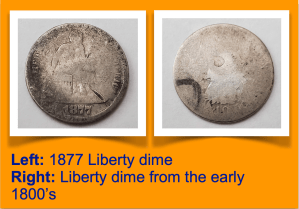
However, upon further examination, I realized these two coins weren’t slugs at all, but dimes that were older than the typical Roosevelt dimes that have been in circulation since the 1940’s.


One of the dimes is an 1877 Liberty dime and the other coin is so worn that it’s hard to determine the exact date but I’m reasonably certain it’s a Liberty dime from the early 1800’s.

Before you cry “Eureka”, know that I learned that these coins are much too worn to have any substantial value, but they are still interesting finds, nonetheless. It simply confirms to me that you never know what hidden treasures are buried within the landscape of our stuff.

Part of our ministry to Young Professionals is helping them to find their unique place of ministry in God’s Kingdom. Often this involves helping them unearth the hidden treasures of unique talents with which God has blessed them.

Grace and Jen pose together in front of two of Grace’s paintings on display at an AAPI Art Exhibit. Click the photo to go to Grace’s Etsy store.

I think about Grace, a Young Professional Jen has been coaching and mentoring. Grace studied to be an engineer and worked as an Environmental Engineer for several years before getting laid off.

It turns out that Grace is incredibly creative and artistic and she now had the space to explore these talents. 

As part of Asian American Pacific Islander Heritage Month, Jen and I attended an Art Exhibit at Saddleback Church, highlighting artists of Asian American/Pacific Islander descent. Grace was one of the highlighted artists.

Imagine the power and freedom when you discover your passions and learn to express your talents in a way that glorifies God and brings joy and blessing to others!

CLICK HERE TO CHECK OUT GRACE’S ETSY STORE

Thank you for your partnership that enables us to minister to Young Professionals, helping them to unleash their incredibly unique talents in new and creative ways.

A Mark of Immaturity

1 Corinthians 3

1Dear brothers and sisters, when I was with you I couldn’t talk to you as I would to mature Christians. I had to talk as though you belonged to this world or as though you were infants in the Christian life. 2I had to feed you with milk and not with solid food, because you couldn’t handle anything stronger. And you still aren’t ready, 3for you are still controlled by your own sinful desires. You are jealous of one another and quarrel with each other. Doesn’t that prove you are controlled by your own desires? You are acting like people who don’t belong to the Lord. 4When one of you says, “I am a follower of Paul,” and another says, “I prefer Apollos,” aren’t you acting like those who are not Christians? 5Who is Apollos, and who is Paul, that we should be the cause of such quarrels? Why, we’re only servants. Through us God caused you to believe. Each of us did the work the Lord gave us. 6My job was to plant the seed in your hearts, and Apollos watered it, but it was God, not we, who made it grow. 7The ones who do the planting or watering aren’t important, but God is important because he is the one who makes the seed grow. 8The one who plants and the one who waters work as a team with the same purpose. Yet they will be rewarded individually, according to their own hard work. 9We work together as partners who belong to God. You are God’s field, God’s building—not ours.  (1 Corinthians 3:1-9, NLT)


The Daily DAVEotional

According to Wikipedia, between 65 and 75 percent of Americans identify as Christians. Does that sound right?

Regardless of whether you consider wikipedia to be a reliable source of information on this subject, there is no disputing that a high percentage of Americans identify as Christians over other religious ideologies and non-religious philosophies.

However, the evidence of daily life, whether in the physical or online world, doesn’t seem to support the notion that so many people identify themselves as Christians. The majority of people simply don’t seem to act like Christians.

What is the problem?

Paul gives some insight to the problem in this passage. A major issue that the Corinthian church was dealing with was the problem of name-dropping and identifying and aligning themselves with certain religious leaders. It was the source of much disunity and division within this church. I wrote about this issue in a previous blog post here.

In this passage Paul plainly states that many within this Corinthian church are not mature. In verse 2, he states that he had to feed them milk and not solid food because they weren’t ready for solid food.

Now there’s nothing wrong if you are not able to eat solid food depending on the circumstances.

Think about a baby. A baby doesn’t have teeth and their digestive system is not ready for solid foods. As a result, they drink milk, either from their mother’s breasts or from some pre-made formula. As they grow and mature, however, the parents typically will begin to introduce various forms of solid food into their baby’s diet. At first, they might feed their child mashed or pureed vegetables or protein, gradually moving up to soft, chewable foods like Cheerios or small, soft vegetables or fruit pieces.

But imagine a toddler who hasn’t graduated to any form of solid food. Does that seem normal? If you saw what looked like a normal, active 5 year old crawl into his mother’s lap in order to take nourishment from his mother’s breasts as if he were a 5 month old, you would probably suspect something wasn’t normal.

This is the problem in the Corinthian church. There’s no problem with needing milk, spiritually speaking, if you are a baby Christian. But when Paul says, “And you still aren’t ready” [for solid food], the implication is that they SHOULD be ready for it.

Why weren’t they ready for it? Paul says that the reason they had not developed to a more mature point is because “you are still controlled by your own sinful desires.”

Hence, a primary marker of maturity among Christians is they are no longer controlled by their own selfish desires. Another way of putting it is immature Christians are still controlled by selfish desires.

This could be one explanation for how so many people in our country could claim to be Christian and yet their lives don’t reflect it.

Of course there are many indicators of selfishness, but one that Paul highlights here is a person’s penchant for aligning themselves with another leader or personality. Paul says that this is wrong and selfish because it robs God of his rightful worship as the ultimate person responsible for the spiritual growth and development that we may experience and attaches it to someone who is merely God’s servant doing God’s work.

If we want to move past the baby Christian phase, it will become necessary for us to learn to put aside our self-centeredness, including our tendency to elevate and idolize leadership personalities and begin to make God Himself the central focus of our lives and our spiritual development.


Did you enjoy this post? I’d love to hear your thoughts! Feel free to like, leave a comment below, and share it with your friends or on social media if you found it helpful or interesting. Your support keeps the conversation going!


Reflection

What do you think Paul means when he talks about feeding them with milk? Additionally, what is meant by solid food?

As you evaluate your own spiritual development, would you consider yourself a Christian who feeds on milk or solid food? What reasons would you give to support your conclusion?

What are some practical ways a young Christian can move from milk to solid food?

Who are some Christian leadership personalities that you think some Christians may be prone to align themselves with? 

What steps can you take to ensure that you don’t improperly idolize those who may be significantly influential in your life?


Photo by Kelly Sikkema on Unsplash

The Shortest (Non) Prayer in the Bible

Nehemiah 2

1Early the following spring, during the twentieth year of King Artaxerxes’ reign, I was serving the king his wine. I had never appeared sad in his presence before this time. 2So the king asked me, “Why are you so sad? You aren’t sick, are you? You look like a man with deep troubles.”

Then I was badly frightened, 3but I replied, “Long live the king! Why shouldn’t I be sad? For the city where my ancestors are buried is in ruins, and the gates have been burned down.”

4The king asked, “Well, how can I help you?”

With a prayer to the God of heaven, 5I replied, “If it please Your Majesty and if you are pleased with me, your servant, send me to Judah to rebuild the city where my ancestors are buried.”

6The king, with the queen sitting beside him, asked, “How long will you be gone? When will you return?” So the king agreed, and I set a date for my departure. (Nehemiah 2:1-6, NLT)


The Daily DAVEotional

The book of Nehemiah is a classic study on effective leadership.

Nehemiah is a Jew in exile who happens to be the cupbearer to the King. When Nehemiah gets word that the wall in the city of Jerusalem is in ruins he’s understandably distraught. The king notices Nehemiah’s sullen demeanor, which could have been disastrous for Nehemiah given his position, but fortunately, the king is compassionate and inquires about the nature of Nehemiah’s anguish.

Nehemiah shares about the news he received concerning Jerusalem and to Nehemiah’s surprise, the king asks, “well, how can I help you?”

What comes next in the text is what I find most interesting. It says, “With a prayer to the God of heaven, I replied…”

Nehemiah prayed to God before making his request to the king, a request which was certainly bold in nature.

It might be easy to overlook the significance of this verse. After all, it seems quite reasonable that Nehemiah would pray before making such a bold request of the king.

But think about it for just a moment. Did Nehemiah really pray? It’s not likely he had the time to pause, kneel, close his eyes and pray to the Lord, at least not as we tend to think about prayer.

This “prayer” was made in the middle of a back-and-forth conversation with the king. Nehemiah did not have the time to beseech the Lord in the traditional way we think of prayer. It would not have even been appropriate for Nehemiah to make a traditional prayer in the king’s presence while he awaited a response from Nehemiah to his question.

So if Nehemiah didn’t actually pray, how is it that the text can say Nehemiah prayed?

I think the key is the phrase “with a prayer to the God of heaven, I replied…”

Nehemiah didn’t stop to pray as we think about it. Instead, he prayed AS he replied to the king. In other words, at the same time he was engaging the king, he was inviting the God of heaven to give him wisdom, to give him favor in the eyes of the king and to grant the request he was about to make.

This may be a paradigm shift in how you think about prayer. Prayer is not JUST a focused time where we lift our requests up to God. Prayer is not JUST a dedicated time of solitude where we pause, reflect and lift up our praises and requests to God. Instead, prayer is an attitude of dependence and reliance on God that we can practice at all times. Prayer, essentially, is directing our thoughts towards God, whether it is audible or not, visible or invisible.

In Nehemiah’s case, he obviously didn’t stop, pause and lift up an audible prayer to God. Nehemiah’s prayer was in reality more of a heart attitude toward God in which he, in that moment, was acknowledging his dependence on God and exercising faith that God would speak through him and grant him favor in the king’s eyes.

And God honored Nehemiah’s prayer and granted his request before the king.

You may not be able to set aside hours each day for dedicated prayer. You may not be able to set aside even 30 minutes, though this discipline can have many benefits. But no matter how much time you may have to set aside for uninterrupted prayer, Nehemiah’s example demonstrates that we can pray at any moment and dedicated, focused time in prayer is not requisite in order to connect with the God of heaven!

Reflection

What has been your practice and discipline with prayer in the past?

How have you thought of prayer in the past? How have you defined and understood the nature and practice of prayer?

In what ways does Nehemiah’s example challenge your view and understanding of prayer?

In what ways can you implement Nehemiah’s example and make prayer more of an ongoing connection with God in which you are constantly directing your thoughts towards Him?

Photo by Rock Staar on Unsplash


LinkedIn, CBMC and Helping Young Adults Embark

I was recently invited to attend a quarterly breakfast for the Orange County Chapter of CBMC (Christian Businessman’s Connection). 

Marc Ottestad, the coordinator of the group, had connected with me via LinkedIn, thinking that our similar interests and passion for coaching, mentoring and seeing men make an impact for Jesus in their jobs might make for some natural opportunities to collaborate.

When I showed up at the breakfast, I noticed that most of the men were my age or even older. I wasn’t sure what to expect or how this breakfast might directly help me.

At one point, we were asked to shuffle tables to meet some new people and discuss what we heard from the speaker.

I found another table and ended up sitting next to the only guy in the room who was younger than 30.

I introduced myself to Alec and learned that he had recently graduated from Biola and was working at expanding a website business.

When Alec asked what I do, I shared that I help Young Professionals thrive spiritually and live with purpose.

Alec is a recent graduate of Biola University who is seeking biblical community while working to build and expand his website business.

I explained that my wife and I had spent many years ministering to college students but we made a shift in our ministry focus a few years ago because we had seen a void in Christian circles in serving the needs of Young adults, who are often struggling to find the kind of community and support that they need when they are undergoing the biggest changes and most stressful transitions of their life.

Alec’s response was both sad and affirming at the same time. He said, “you pretty much just summed up my current life situation.”

It’s sad that there seems to be so few resources and support for young professionals like Alec. I’ve spent many hours thinking through this issue, trying to determine why this is the case. 

My conclusions are not researched…they are just opinions, yet it makes sense to me.

If you think about it, most churches are built around a family model. Nearly every church serves the needs of families – from kids programs to youth events as well as support for parents and marriages.

This is an extremely good thing because, if you haven’t noticed, the traditional family unit, with biblical family values is under attack in our culture. The church may be the last bastion of hope to salvage a biblical understanding of the family unit.

But that same model works against Young Professionals, who are in a season where they have often left their family of origin and are yet to start a family of their own. They are in an in-between season of life – living on their own, learning to live as an adult with real-life responsibilities.

In this in-between phase, which is lasting longer for current 20-Somethings than it has for previous generations, they are looking for others like them with whom they can experience the struggles and transitions of becoming an adult.

Jen and I regularly connect with Young Adults who share their frustrations with attending churches where they struggle to find other Young Adults.

I have heard a number of church leaders tell me that a specific ministry meeting the needs of Young Adults is unnecessary. Citing the benefits of inter-generational worship and community, they contend that Young Adults should simply get involved in the life of the church,.

I believe this view is short-sighted. Research demonstrates that Young Professionals DO want mentors and they DO want to be involved in the life of the church. So in one sense, the idea of inter-generational worship and involvement makes sense. But a weekly men’s group cannot fill the void that’s lacking for many Young Adults – the need for a family-like experience with peers while they are in the season of single-ness.

We don’t have all the answers and we’re still learning best practices as we seek to minister to this audience. But we are seeking to fill the gap in various ways. 

After meeting Alec for lunch, I was able to connect him to a Leadership Development group that I recently launched. One of the guys in the group is also a Biola grad with whom Alec was acquainted. 

We’re also exploring the benefits of coaching. It may not meet all of Alec’s needs, but our hope is that it will provide a few missing elements that will help Alec, and others like him, to thrive spiritually and live with purpose during this season of life!


You Can Run But You Can’t Hide!

Jonah 1

1The LORD gave this message to Jonah son of Amittai: 2“Get up and go to the great city of Nineveh! Announce my judgment against it because I have seen how wicked its people are.”

3But Jonah got up and went in the opposite direction in order to get away from the LORD. He went down to the seacoast, to the port of Joppa, where he found a ship leaving for Tarshish. He bought a ticket and went on board, hoping that by going away to the west he could escape from the LORD.

4But as the ship was sailing along, suddenly the LORD flung a powerful wind over the sea, causing a violent storm that threatened to send them to the bottom. 5Fearing for their lives, the desperate sailors shouted to their gods for help and threw the cargo overboard to lighten the ship. And all this time Jonah was sound asleep down in the hold. 6So the captain went down after him. “How can you sleep at a time like this?” he shouted. “Get up and pray to your god! Maybe he will have mercy on us and spare our lives.”

7Then the crew cast lots to see which of them had offended the gods and caused the terrible storm. When they did this, Jonah lost the toss. 8“What have you done to bring this awful storm down on us?” they demanded. “Who are you? What is your line of work? What country are you from? What is your nationality?”

9And Jonah answered, “I am a Hebrew, and I worship the LORD, the God of heaven, who made the sea and the land.” 10Then he told them that he was running away from the LORD.

The sailors were terrified when they heard this. “Oh, why did you do it?” they groaned. 11And since the storm was getting worse all the time, they asked him, “What should we do to you to stop this storm?”

12“Throw me into the sea,” Jonah said, “and it will become calm again. For I know that this terrible storm is all my fault.”

13Instead, the sailors tried even harder to row the boat ashore. But the stormy sea was too violent for them, and they couldn’t make it. 14Then they cried out to the LORD, Jonah’s God. “O LORD,” they pleaded, “don’t make us die for this man’s sin. And don’t hold us responsible for his death, because it isn’t our fault. O LORD, you have sent this storm upon him for your own good reasons.”

15Then the sailors picked Jonah up and threw him into the raging sea, and the storm stopped at once! 16The sailors were awestruck by the LORD’s great power, and they offered him a sacrifice and vowed to serve him.

17Now the LORD had arranged for a great fish to swallow Jonah. And Jonah was inside the fish for three days and three nights. (Jonah 1:1-17, NLT)


The Daily DAVEotional

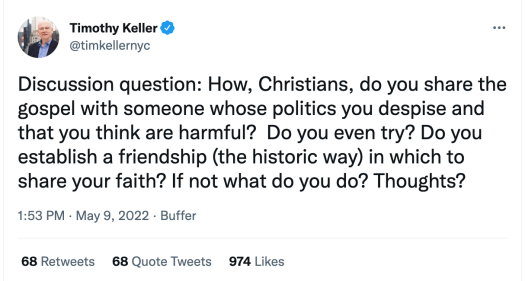
Earlier this evening, I saw the following tweet from renowned pastor and theologian, Tim Keller:

Interestingly, Jonah chapter one outlines this exact situation.

Jonah was a prophet of Israel at a time when the biggest, baddest guys in the neighborhood were the Assyrians. The Assyrians were the super power of the day, overtaking and subjecting every nation and every culture to its will and dominance.

Imagine Jonah’s surprise when God tells Jonah that He wants him to go to Nineveh, the capital city of Assyria, and announce God’s judgment on the people there. God wants to give the Ninevites a chance to respond to His impending judgment and He wants Jonah to be His prophetic instrument.

Jonah cannot wrap his brain around the idea that God would give the Assyrians an opportunity to repent and be saved. He is so repulsed by the thought that these evil, wicked Assyrians might hear a message of judgment and then repent and be saved that he runs in the opposite direction.

On the surface, it’s easy to throw shade at Jonah for rejecting God’s command and running away. It’s hard to understand why Job resists God instead of just doing what He asks. But actually, Jonah’s response is probably more typical than outlier.

How empathetic and compassionate are you towards the person or the people whom you hate the most? Do you find yourself moving toward them in love as we’re commanded in Scripture or do you find yourself hoping and praying for their destruction? This is the gist of Tim Keller’s tweet above.

This passage from Jonah demonstrates that God is not just a God of the Jews, as most Jews believed, but He has love and compassion for all people, even Gentiles. For the Jew during Jonah’s day, this would have been a complete paradigm shift. For us today, we might say that God is not just the God of my political party, but He is the God of those who have opposing views as well!

Chapter one of Jonah also demonstrates that we cannot hide from God or escape His will and plan for our lives. God’s purposes will be accomplished whether or not we comply with His will.

Lastly, we learn that God can use even our rebellion and resistance to follow Him for His ultimate glory. Even though Jonah resists God, the sailors on the ship are so awed by God’s great power that they sacrifice to Him and promise to serve Him.


Did you enjoy this post? I’d love to hear your thoughts! Feel free to like, leave a comment below, and share it with your friends or on social media if you found it helpful or interesting. Your support keeps the conversation going!


Reflection

What are some things God has been telling you to do that you’ve been unwilling to do? Why?

What is the group that would be the most difficult for you to demonstrate love and compassion toward? What makes it difficult?

What are some instances where God used a negative or difficult situation for His ultimate glory?


Photo by Maximilian Weisbecker on Unsplash

Are You Good Enough?

Mark 10

17As Jesus started on his way, a man ran up to him and fell on his knees before him. “Good teacher,” he asked, “what must I do to inherit eternal life?”

18“Why do you call me good?” Jesus answered. “No one is good—except God alone. 19You know the commandments: ‘Do not murder, do not commit adultery, do not steal, do not give false testimony, do not defraud, honor your father and mother.’”

20“Teacher,” he declared, “all these I have kept since I was a boy.”

21Jesus looked at him and loved him. “One thing you lack,” he said. “Go, sell everything you have and give to the poor, and you will have treasure in heaven. Then come, follow me.”

22At this the man’s face fell. He went away sad, because he had great wealth.

23Jesus looked around and said to his disciples, “How hard it is for the rich to enter the kingdom of God!”

24The disciples were amazed at his words. But Jesus said again, “Children, how hard it is to enter the kingdom of God! 25It is easier for a camel to go through the eye of a needle than for a rich man to enter the kingdom of God.”

26The disciples were even more amazed, and said to each other, “Who then can be saved?”

27Jesus looked at them and said, “With man this is impossible, but not with God; all things are possible with God.” (Mark 10:17-27, NLT)


The Daily DAVEotional

This story in Mark 10 is also shared by Matthew in the 19th chapter of his account of the life of Jesus. I wrote about this story about a year ago here, in which I addressed the question of whether or not Jesus requires rich people to give up their possessions in order to be saved.

You can read my thoughts about that in the previous blog post as I’m not intending to regurgitate all my thoughts again here. Instead, I want to focus on an often overlooked part of the exchange Jesus has with this person of extreme wealth.

The passage starts with the man coming to Jesus and asking Jesus what is required to inherit eternal life. But what is often overlooked is how he addresses Jesus. He calls Jesus “good teacher”.

Jesus picks up on this and replies in verse 18, “Why do you call me good?….No one is good except God alone.”

You almost never hear any sermon that focuses on this verse or gives any explanation of why it’s there. In fact, if you just eliminated verse 18 from the story altogether, the main idea and explanation seems to remain unchanged. In other words. Jesus’ response to how the man addressed him does not appear to be central to the main point of the story, which is the idea that coming to Jesus and inheriting eternal life requires us to recognize our spiritual brokenness and our need for a savior.

So if Jesus’ response is not important to the main idea in the story, why is it there?

Jesus is using this exchange to fundamentally change our idea of what is considered good.

Think about it. Almost everyone everywhere thinks that making it to heaven is a matter of being a good person and I’ve never met a person who, no matter what bad things they may have done in their lives, didn’t consider themselves to be good. Jesus’s response alters the equation of what is required to gain eternal life, which is the central query of the rich young ruler.

Do you think you’re a good person? Jesus says that ONLY GOD is good. Jesus also indirectly points to his own deity in the process when he asks, “why do you call me good….no one is good except God.” Jesus is pressing the implication that calling him good is tantamount to calling him God, since only God is good.

The rest of the story is simply a process by which Jesus reveals to the rich young ruler that he does not measure up to the standard of goodness (perfection) that is required to gain eternal life.

The disciples asked, “Who then can be saved?”

Jesus responded that with man, it is impossible. Why? Because no man can achieve the perfect goodness required to save himself.

But all things are possible with God. Jesus makes the impossible possible through His death on the cross!

Reflection

What has been your concept of goodness in the past? What is the standard you use to determine whether a person is good or not?

Do you agree with people who say that most people are basically good? Why or why not?

Do you think it’s possible for people to save themselves?

What do you think is required to inherit eternal life? How would you explain it to someone else?


Photo by Hello I’m Nik on Unsplash