You Can Run But You Can’t Hide!

1The LORD gave this message to Jonah son of Amittai: 2“Get up and go to the great city of Nineveh! Announce my judgment against it because I have seen how wicked its people are.”

3But Jonah got up and went in the opposite direction in order to get away from the LORD. He went down to the seacoast, to the port of Joppa, where he found a ship leaving for Tarshish. He bought a ticket and went on board, hoping that by going away to the west he could escape from the LORD.

4But as the ship was sailing along, suddenly the LORD flung a powerful wind over the sea, causing a violent storm that threatened to send them to the bottom. 5Fearing for their lives, the desperate sailors shouted to their gods for help and threw the cargo overboard to lighten the ship. And all this time Jonah was sound asleep down in the hold. 6So the captain went down after him. “How can you sleep at a time like this?” he shouted. “Get up and pray to your god! Maybe he will have mercy on us and spare our lives.”

7Then the crew cast lots to see which of them had offended the gods and caused the terrible storm. When they did this, Jonah lost the toss. 8“What have you done to bring this awful storm down on us?” they demanded. “Who are you? What is your line of work? What country are you from? What is your nationality?”

9And Jonah answered, “I am a Hebrew, and I worship the LORD, the God of heaven, who made the sea and the land.” 10Then he told them that he was running away from the LORD.

The sailors were terrified when they heard this. “Oh, why did you do it?” they groaned. 11And since the storm was getting worse all the time, they asked him, “What should we do to you to stop this storm?”

12“Throw me into the sea,” Jonah said, “and it will become calm again. For I know that this terrible storm is all my fault.”

13Instead, the sailors tried even harder to row the boat ashore. But the stormy sea was too violent for them, and they couldn’t make it. 14Then they cried out to the LORD, Jonah’s God. “O LORD,” they pleaded, “don’t make us die for this man’s sin. And don’t hold us responsible for his death, because it isn’t our fault. O LORD, you have sent this storm upon him for your own good reasons.”

15Then the sailors picked Jonah up and threw him into the raging sea, and the storm stopped at once! 16The sailors were awestruck by the LORD’s great power, and they offered him a sacrifice and vowed to serve him.

17Now the LORD had arranged for a great fish to swallow Jonah. And Jonah was inside the fish for three days and three nights. (Jonah 1:1-17, NLT)


The Daily DAVEotional

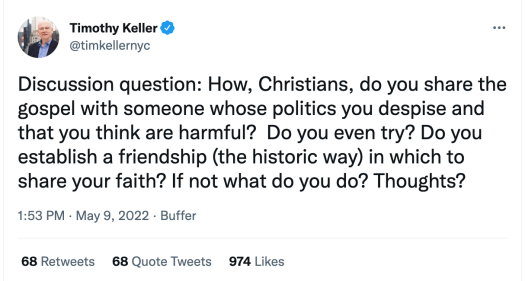
Earlier this evening, I saw the following tweet from renowned pastor and theologian, Tim Keller:

Interestingly, Jonah chapter one outlines this exact situation.

Jonah was a prophet of Israel at a time when the biggest, baddest guys in the neighborhood were the Assyrians. The Assyrians were the super power of the day, overtaking and subjecting every nation and every culture to its will and dominance.

Imagine Jonah’s surprise when God tells Jonah that He wants him to go to Nineveh, the capital city of Assyria, and announce God’s judgment on the people there. God wants to give the Ninevites a chance to respond to His impending judgment and He wants Jonah to be His prophetic instrument.

Jonah cannot wrap his brain around the idea that God would give the Assyrians an opportunity to repent and be saved. He is so repulsed by the thought that these evil, wicked Assyrians might hear a message of judgment and then repent and be saved that he runs in the opposite direction.

On the surface, it’s easy to throw shade at Jonah for rejecting God’s command and running away. It’s hard to understand why Job resists God instead of just doing what He asks. But actually, Jonah’s response is probably more typical than outlier.

How empathetic and compassionate are you towards the person or the people whom you hate the most? Do you find yourself moving toward them in love as we’re commanded in Scripture or do you find yourself hoping and praying for their destruction? This is the gist of Tim Keller’s tweet above.

This passage from Jonah demonstrates that God is not just a God of the Jews, as most Jews believed, but He has love and compassion for all people, even Gentiles. For the Jew during Jonah’s day, this would have been a complete paradigm shift. For us today, we might say that God is not just the God of my political party, but He is the God of those who have opposing views as well!

Chapter one of Jonah also demonstrates that we cannot hide from God or escape His will and plan for our lives. God’s purposes will be accomplished whether or not we comply with His will.

Lastly, we learn that God can use even our rebellion and resistance to follow Him for His ultimate glory. Even though Jonah resists God, the sailors on the ship are so awed by God’s great power that they sacrifice to Him and promise to serve Him.

Reflection

What are some things God has been telling you to do that you’ve been unwilling to do? Why?

What is the group that would be the most difficult for you to demonstrate love and compassion toward? What makes it difficult?

What are some instances where God used a negative or difficult situation for His ultimate glory?


Photo by Maximilian Weisbecker on Unsplash

Are You Good Enough?

Mark 10

17As Jesus started on his way, a man ran up to him and fell on his knees before him. “Good teacher,” he asked, “what must I do to inherit eternal life?”

18“Why do you call me good?” Jesus answered. “No one is good—except God alone. 19You know the commandments: ‘Do not murder, do not commit adultery, do not steal, do not give false testimony, do not defraud, honor your father and mother.’”

20“Teacher,” he declared, “all these I have kept since I was a boy.”

21Jesus looked at him and loved him. “One thing you lack,” he said. “Go, sell everything you have and give to the poor, and you will have treasure in heaven. Then come, follow me.”

22At this the man’s face fell. He went away sad, because he had great wealth.

23Jesus looked around and said to his disciples, “How hard it is for the rich to enter the kingdom of God!”

24The disciples were amazed at his words. But Jesus said again, “Children, how hard it is to enter the kingdom of God! 25It is easier for a camel to go through the eye of a needle than for a rich man to enter the kingdom of God.”

26The disciples were even more amazed, and said to each other, “Who then can be saved?”

27Jesus looked at them and said, “With man this is impossible, but not with God; all things are possible with God.” (Mark 10:17-27, NLT)


The Daily DAVEotional

This story in Mark 10 is also shared by Matthew in the 19th chapter of his account of the life of Jesus. I wrote about this story about a year ago here, in which I addressed the question of whether or not Jesus requires rich people to give up their possessions in order to be saved.

You can read my thoughts about that in the previous blog post as I’m not intending to regurgitate all my thoughts again here. Instead, I want to focus on an often overlooked part of the exchange Jesus has with this person of extreme wealth.

The passage starts with the man coming to Jesus and asking Jesus what is required to inherit eternal life. But what is often overlooked is how he addresses Jesus. He calls Jesus “good teacher”.

Jesus picks up on this and replies in verse 18, “Why do you call me good?….No one is good except God alone.”

You almost never hear any sermon that focuses on this verse or gives any explanation of why it’s there. In fact, if you just eliminated verse 18 from the story altogether, the main idea and explanation seems to remain unchanged. In other words. Jesus’ response to how the man addressed him does not appear to be central to the main point of the story, which is the idea that coming to Jesus and inheriting eternal life requires us to recognize our spiritual brokenness and our need for a savior.

So if Jesus’ response is not important to the main idea in the story, why is it there?

Jesus is using this exchange to fundamentally change our idea of what is considered good.

Think about it. Almost everyone everywhere thinks that making it to heaven is a matter of being a good person and I’ve never met a person who, no matter what bad things they may have done in their lives, didn’t consider themselves to be good. Jesus’s response alters the equation of what is required to gain eternal life, which is the central query of the rich young ruler.

Do you think you’re a good person? Jesus says that ONLY GOD is good. Jesus also indirectly points to his own deity in the process when he asks, “why do you call me good….no one is good except God.” Jesus is pressing the implication that calling him good is tantamount to calling him God, since only God is good.

The rest of the story is simply a process by which Jesus reveals to the rich young ruler that he does not measure up to the standard of goodness (perfection) that is required to gain eternal life.

The disciples asked, “Who then can be saved?”

Jesus responded that with man, it is impossible. Why? Because no man can achieve the perfect goodness required to save himself.

But all things are possible with God. Jesus makes the impossible possible through His death on the cross!

Reflection

What has been your concept of goodness in the past? What is the standard you use to determine whether a person is good or not?

Do you agree with people who say that most people are basically good? Why or why not?

Do you think it’s possible for people to save themselves?

What do you think is required to inherit eternal life? How would you explain it to someone else?


Photo by Hello I’m Nik on Unsplash

Is Wealth Immoral? (Part 3)

Ecclesiastes 5

10Those who love money will never have enough. How absurd to think that wealth brings true happiness! 11The more you have, the more people come to help you spend it. So what is the advantage of wealth—except perhaps to watch it run through your fingers!

12People who work hard sleep well, whether they eat little or much. But the rich are always worrying and seldom get a good night’s sleep.

13There is another serious problem I have seen in the world. Riches are sometimes hoarded to the harm of the saver, 14or they are put into risky investments that turn sour, and everything is lost. In the end, there is nothing left to pass on to one’s children. 15People who live only for wealth come to the end of their lives as naked and empty-handed as on the day they were born.

16And this, too, is a very serious problem. As people come into this world, so they depart. All their hard work is for nothing. They have been working for the wind, and everything will be swept away. 17Throughout their lives, they live under a cloud—frustrated, discouraged, and angry.

18Even so, I have noticed one thing, at least, that is good. It is good for people to eat well, drink a good glass of wine, and enjoy their work—whatever they do under the sun—for however long God lets them live. 19And it is a good thing to receive wealth from God and the good health to enjoy it. To enjoy your work and accept your lot in life—that is indeed a gift from God. 20People who do this rarely look with sorrow on the past, for God has given them reasons for joy. (Ecclesiastes 5:10-20)


The Daily DAVEotional

You may have seen in the news recently that President Joe Biden has decided to implement a “wealth tax” in his next proposed budget. The idea would be to tax those who make over $100 million a minimum of 20%.

Predictably, some are heralding this move as a positive step as it’s “about time the rich pay their fair share” while others have noted that the majority of taxes collected by the IRS are already paid by the rich, so what is the limit of what is fair?

My point is not to take a side in this particular legislation but to demonstrate that we live in an era where it has become fashionable by many, including Christians, to decry wealth as being immoral. Jesus himself seemed to care for the underserved and underprivileged so it is even asserted by some that Jesus was against wealth.

I wrote about this last year in a series of posts here and here. The problem for Christians who think that wealth is immoral is that there is nowhere in Scripture where wealth is actually condemned. Additionally, many righteous men and women of faith were people of great means.

I explain how these ideas are reconciled biblically in the previous posts but here, in today’s passage, Solomon, one of the wealthiest men in the Biblical record, helps us understand more deeply God’s view of wealth.

Here are some of the highlights:

    • Solomon doesn’t condemn wealth. He himself was EXTREMELY wealthy. But he does point out that the LOVE of money is futile because it cannot bring true happiness (verse 10).
    • One problem that comes along with great wealth is that others come to help you spend it. Many lottery winners have commented on how much more stressful life became when they hit it big. Not only was there the worry of how to keep what they have won but suddenly, everyone you’ve ever known shows up wanting a piece of the pie (verse 11).
    • People who have great wealth can sometimes lose it all because, as Solomon points out, the money is put into risky investments (verses 13-14). How many sad stories are told of athletes who made millions while playing but who are living in poverty because they didn’t know how to manage their money?

Solomon’s admonition against the dangers of wealth can be summed up in verse 15:

People who live only for wealth come to the end of their lives as naked and empty-handed as on the day they were born.

Notice that Solomon doesn’t condemn wealth but warns against “living only for wealth”. This is another way of describing greed. The problem with living only for wealth is that you can’t take it with you. Wealthy people will die with nothing just as everyone else does. Jesus made this same point in the Luke 12 passage that I blogged about here.

Solomon ends his short discourse by actually saying that receiving wealth from God is a GOOD thing. He declares that wealth and the good health to enjoy it is a gift from God.

It seems clear from Scripture that wealth in and of itself is not bad. The real issues that are problematic are greed and envy. These two sinful vices are not reserved for the wealthy alone but for anyone regardless of your financial position.

Whatever your net worth is, the biblical admonition is to be content, not envying what others have or being greedy for more of what you think might make life more comfortable and enjoyable.

We should heed Solomon’s admonition to “enjoy your work and accept your lot in life….People who do this rarely look with sorrow on the past, for God has given them reasons for joy.” (Ecclesiastes 5:19-20)

Reflection

On a scale of 1-10, how would you rate your contentment with your current financial position?

Do you think money can bring true happiness? What are you relying on to provide happiness in your own life?

Do you agree with Solomon’s statement that people should enjoy their work and accept their lot in life? Why or why not?

What does it look like to “live only for money”? Have you ever had this attitude or disposition towards money?

When was a time when you experienced feelings of greed or envy? How can you ensure that your own heart motivations towards money and wealth are godly?


Photo by David McBee: https://www.pexels.com/photo/bitcoins-and-u-s-dollar-bills-730547/

“Sticks and Stones…” Revisited

Proverbs 18

4 A person’s words can be life-giving water; words of true wisdom are as refreshing as a bubbling brook. (Proverbs 18:4)

14 The human spirit can endure a sick body, but who can bear it if the spirit is crushed? (Proverbs 18:14)

20 Words satisfy the soul as food satisfies the stomach; the right words on a person’s lips bring satisfaction. (Proverbs 18:20)

21 Those who love to talk will experience the consequences, for the tongue can kill or nourish life. (Proverbs 18:21)


The Daily DAVEotional

When I was about 5 or 6 years old, my parents invited some friends over to the house. They had kids who were about the same age as me and my brother so while my parents were entertaining their guests, we were hanging out as a group of kids.

I’m the youngest in my family and was always very small for my age. As a result, I was often teased by older kids and even peers for being small.

I vividly remember being teased in this setting. Though I don’t remember the exact nature of the teasing, I do remember going to my mother and telling her that the other kids were making fun of me.

Her response was the classic line, “You tell them that ‘Sticks and stones may break my bones but words can never hurt me.’

I soon learned that this phrase was a stock response to schoolyard bullying and verbal jabs and I used it frequently, until of course, I discovered more sophisticated ways of responding to the insults of others, such as the mocking “Neener, neener” and the classic “I know you are but what am I?”

The problem with the “Sticks and Stones” phrase is that it’s not true.

Of course there’s an element of truth to the saying. Yes, words cannot inflict physical damage on our bodies. But as Proverbs 18 shows, our words can bring life and healing to others OR they can wound or kill others.

The phrase disregards the sensitive nature of our emotions and our spirit.

Think about it. Our bodies have an immune system which fights off infections when we are sick.

Our bodies also have a repair system that kicks in when we are injured. An open wound will heal and even broken or fractured bones will heal themselves, though obviously, compound fractures may require special setting in order for proper healing to take place.

We don’t have an emotional immune system though to repair our minds when we are discouraged or damaged emotionally. We can carry the scars and wounds of emotional trauma for years.

We live in a culture where we can instantly communicate with just about anyone we want, and with social media, our words have an extensive reach that was unthinkable even 20 or 30 years ago.

There is a lot of anger and vitriol these days, especially on Social media platforms. Personally, I need constant reminders of the power of my words so that I don’t give in to the temptation to berate and belittle others, with no regard for the impact it has on them.

Reflection

Think of a time when you were teased as a kid? How did it make you feel? What emotions and thoughts do you have now as you remember that experience?

When is a time when your words wounded another person? What did you say? Have you asked for forgiveness and reconciled with that person?

When was a time when someone gave you life-giving words that nourished your soul? What was the context and in what ways did those words lift your spirit?

What has been your experience with your words on social media? What steps can you take to ensure that your words on social media are life-giving and not wounding or harming others?


Photo by Simon Wilkes on Unsplash


Super Results!

The Super Bowl is perhaps the biggest sporting event each year in America and each year, the day before the Super Bowl, Athletes in Action, the sports ministry of Cru, hosts a Super Bowl breakfast in the host city.

The Super Bowl Breakfast program

This year, the Super Bowl and Super Bowl breakfast was in Los Angeles for the first time since 1993.

This event is not a casual affair. 1500 attendees experience a top-notched, NFL-sanctioned event featuring some of the biggest names in the NFL.

The program honors a recipient of the Bart Starr Award, which is given to an NFL player who “best exemplifies outstanding character and leadership in the home, on the field, and in the community.”

Past recipients of the award include Peyton & Eli Manning, Kurt Warner, Drew Brees, Mike Singletary & Reggie White. 

This year’s recipient was Russell Wilson, quarterback for the Seattle Seahawks.

The program highlights the recipient of the annual Bart Starr award and also features a keynote speaker.

In addition to presenting the Bart Starr Award, the program includes a keynote speaker who shares a testimony or a message of faith. This year’s speaker was Frank Reich, the head coach of the Indianapolis Colts.

Pulling off an event as big as this is not easy, and the fact that the event is in a different location each year makes it challenging to secure the manpower to pull it off.

Being on staff with Cru, I was made aware of the need for volunteers and so I made myself available while also recruiting my high school friend and NFL fan Mike to help.

Part of the pre-event prep was setting up 1500 place settings for the breakfast attendees.

Mike and I were assigned security detail, no doubt due to my massive physique and imposing stature.  

It was quite a long day, which involved arriving at the hotel by 5:00 a.m. to help set up tables and then prepare for 1500 guests to arrive.

In addition to helping to ensure that attendees didn’t bother the special guests during the breakfast, Mike and I helped to secure the Guest VIP room that was located off of the lobby area. Our job was to keep eager fans from entering a special room reserved for special guests like Russell Wilson, Anthony Munoz and Ronnie Lott.

My friend Mike poses with Coach O (Ed Orgeron)

While we were waiting for the program to end, we saw Coach Ed Orgeron in the lobby. Coach O, as he’s called, was most recently the head coach of the LSU Tigers and led them to the National championship 3 years ago. His quarterback was Joe Burrow, who is now the quarterback for the Cincinnati Bengals who happened to be playing in this year’s Super Bowl.

Coach O makes a personal phone call to a HUGE fan!

My friend Mike approached Coach O and told him that his dad is from Baton Rouge and is a HUGE LSU fan.

Coach O, in his typical gravelly, Cajun voice asked, “Your daddy, is he alive?”

Mike responded “yes”, to which Coach O replied, “well call him up.”

Mike quickly dialed the number of his dad and handed the phone to Coach O. The exchange went like this:

“Hello Jim….this is Coach O!”

“No it isn’t.”

“Yes, it is. I’m in a hotel lobby and your son Mike tells me you’re a huge LSU fan and so I just called to say ‘Go Tigers.’” 

He then handed the phone back to my friend Mike. 

Dave with Coach O. I’m a Coach O fan as well but for different reasons. He was a coach for the USC Trojans during the success of the Pete Carroll years.

Our job was actually not very glamourous. Other than Coach O, who was not actually there for the Super Bowl breakfast, we didn’t talk to or rub shoulders with any sports celebrities. I had to get my suit altered, I got up at 3:30 a.m. to drive to L.A., paid a small fortune for parking and didn’t eat breakfast or even see most of the program. 

I certainly wasn’t making friends when I had to tell a number of people that the lobby restrooms were not available while being used by certain VIPs.

So why did we do it? What was the benefit? 

The benefit was that because of our help and the generous support of hundreds of other volunteers, 18 people indicated a new commitment to Jesus in response to Coach Reich’s message. And that number is likely much higher due to an online component to the event that is harder to accurately evaluate.

Our job was very much behind the scenes and under the radar, and yet, we rejoice in knowing that people entered the kingdom as a result of the events of that day. When people come to know Jesus, it is rarely a one-person effort but often the result of hundreds, if not thousands of people who each play a small part in the journey. 

We are grateful for the part you play in helping us as we minister to Young Professionals and volunteer at Super Bowl events!

And as a long-time Los Angeles Rams fan, I personally rejoice in a narrow Super Bowl 56 victory!

Who is Jesus?

I have to admit that this past Christmas season was interesting. With all of the travel we had scheduled and with our house being in such disarray due to repairs from our slab leak damage, it was difficult to get in the Christmas spirit.

Normal Christmas reminders were absent as we weren’t able to put up any decorations until just a few days before Christmas.

When life is crazy and chaotic, as it has been for us, it’s easy to lose sight of Jesus.

A few days ago, the Cru Facebook page that I help to monitor received a message from a user in Africa named Mathias.

The message was a simple question: Who is Jesus?

The question “who is Jesus?” is perhaps the most important question that anyone can answer.

Jesus himself asked this question of his followers. In the book of Mark, Jesus recruits 12 men to follow him. Through his teaching, ministry, and many miracles Jesus slowly reveals his identity to his disciples. At the midpoint of the book, Jesus asks his disciples, “who do people say that I am?”

The disciples respond with the popular views of the culture at that time: some say you’re John the Baptist or Elijah; others say you’re a prophet.

Our society has a lot of answers to the question, “who is Jesus?”

Some people believe that Jesus was a great moral teacher – an example for us to follow. Others believe he was a prophet. A few people believe Jesus was a political revolutionary.

Jesus follows with a more pointed question, “who do YOU say that I am?”

Peter answers with the only valid response that hits the mark: Jesus is the Messiah; he is God!

In our fast-paced, materialistic culture, we can sometimes forget who Jesus really is and what he offers. For those of us who have known Jesus for a long-time, the Christmas season can seem rote or routine.

But I’m reminded that there are millions of people who don’t know Jesus, and the idea that God is real and personal is incredibly new and exciting.

People like John, also from Africa, message us every day, wanting to know who God is and how they can know Him.

Though this is a very minimal part of our job, it’s a privilege to be able to tell people all over the world who Jesus is and how they can know Him.

It really is amazing that the God of the universe stepped into humanity in the person of Jesus. He alone offers hope and peace to a world that is desperate and hopeless!


For more information on the Biblical evidence for Jesus’ deity, see my short article “Is Jesus God?”

Some related blog posts you might find helpful:

Does Your Understanding of the Nature of Jesus Really Matter?

Is Your View of Jesus Really that Important? (Part 2)

Further Proof That Jesus is God


Hidden Barriers to Experiencing Change

Jen and I had just parked the car and were heading over to the restaurant, where we were scheduled to meet long-time friends on the first day of our East Coast trip. I glanced at my phone and noticed a new text from our dog sitter. My heart beat instantly elevated as I read the text and learned that there was a water leak in our house.

A quick phone call and some remote sleuthing led me to determine that we likely had a slab leak. Why do these things always seem to happen when we’re out of town? This was the first day of our trip in which we were planning to see our sons at West Point during Parent weekend. I was now wondering if we would have to cut our trip short and head home.

Carpet damage extended beyond the hallway, into the neighboring living room as well as the downstairs bedroom.

The good news was that we had caught it early. Our dog sitter was able to get the water shut off and clean up the water, which was mostly contained in the laundry area and surrounding hallway. It seemed as if we had dodged a bullet and avoided a huge crisis.

However, when we returned from our trip, it quickly became apparent that the damage was more extensive than we had thought. The carpet stains revealed water had gone throughout the downstairs, not just in a small area in front of our laundry closet.

We called a restoration company and learned that there was moisture in a number of walls surrounding the affected areas.

A system of water-filled coolers and thermoses allowed us to use our toilets for a few days.

Our hope was to get the walls dried up and then repipe our house. We figured we could live without running water for a few days so I devised a plan to fill a couple of large coolers with water from my neighbor’s hose. This water would be used to fill our toilet tanks so we could use them.

My plans were dashed as I learned that the restoration company wouldn’t be able to begin work immediately because our house is older and the walls needed to be tested first for lead and asbestos.

Our vinyl tile was “toxic” so it had to be treated by specially qualified professionals.

That took a few days and though our walls ultimately came back negative, the vinyl tile in the laundry area, which was damaged and needed to be removed, did come back positive for asbestos.

That meant we had to get a special abatement crew to remove the vinyl tile.

Two and a half weeks later, we are finally back in our home with actual running water. But there is still much that needs to happen to get back to normal. It will take weeks, if not months, for things to be fully restored.

Unfortunately, the process of repairing what’s broken & getting back to “normal” often takes longer than we hope or expect. The rebuilding process can uncover hidden issues that must be addressed. Sometimes, we even need experts to help us deal with the issues that may be toxic.

I’ve found that in my spiritual life, change is often like the repairs on my house. Spiritually, the things I struggle with are often caused by deeper, hidden issues that are ignored or not properly addressed.

Walls and ceilings had to be opened up throughout our home in order to “fix” the problem and repipe our house.

Real change often means opening up walls and getting inside before things can really be fixed. And sometimes, we can benefit greatly from the help of others who can help us deal with the highly sensitive and toxic issues in our lives that my be holding us back from experiencing the growth and change Jesus wants for us.

Thank you for your partnership with us and your encouragement to us as we navigate the slab leaks of our home and our spiritual lives.

Please pray for us as we deal with insurance, repairs and the costs related to this latest leak.

Making Jesus “Findable” to the World!

Did you know that one of the most frequented internet sites for people wanting to know more about God and Jesus is hosted by Cru?

Since 2002, more than 4 million people have indicated a decision to trust Jesus as a result of visiting one of our evangelistic sites.

Back in February I wrote about how Cru is reaching millions of people through our digital websites everystudent.com and everyperson.com. By utilizing strategic google advertising, literally millions of people from around the world are visiting our sites to learn what it means to trust Jesus for salvation and experience His peace through the adversities of life.

I got involved earlier this year in helping to monitor our Facebook page, which has seen increased interaction as we’ve begun to utilize more advertising on that platform to attract seekers to our site.

A few months ago, Marilyn Adamson, the director of our everystudent.com site sent out a quick e-mail update to let people know how effective the site has been in recent months. I thought you might be encouraged to hear some of the results.

In July, nearly 6 million people visited one of our sites with over 80,000 people indicating a decision for Christ. That’s nearly 2600 people every day making a commitment to Jesus!

Everystudent.com has been translated into more than 40 different languages, giving people from nearly every country in the world an opportunity to access the information on the site in their own language.

Marilyn says, “Many of these people are in India, UK, Egypt, South Africa, Pakistan, China, Australia…all over the world, actually. Some come via a VPN because they live in difficult countries, under threats to them. Yet, in private, God is leading them to EveryStudent.com, then to himself, and revealing himself to them as they grow.”

It’s exciting to see so many lives being changed and it’s especially encouraging to hear from those whose lives have been impacted.

People like Adarkwah, who says, “I appreciate what you are doing for me and am very grateful. I hope by the end of this lesson, I will be the one to tell people how wonderful God is.”

Nikitha says simply, “Thank you so much…my new life has begun.”

Anne wrote, “Thank you for sharing your sites. I read everything you send and more on your sites. Finding this has opened my understanding of faith, grace, etc. It’s amazing! I mean amazing!! I’ll never be able to thank you enough.”

Many of those whose lives have changed by coming to the site and hearing the truth about God and Jesus, are in turn, sharing with others and becoming multiplying disciples.

It’s amazing to me how God uses every avenue at his disposal to reach those who are earnestly seeking him.

The great news is that you can use the site to reach those in your community and sphere of influence as well. To find out how you can make Jesus findable to those around you by utilizing the resources of these websites, go to http://www.everystudent.info. There, you’ll find a wealth of resources that will help you to see the various ways you can actively and passively point people to the site.

Thank you for your prayers and partnership as we seek to make Jesus Findable to Young Adults and the world!

Live Like Molly Day – 2021

NOTE: This is a revision of a post from August 2020. You can access the original post here


It may be the worst fear of every parent – to be awakened in the middle of the night by a phone call telling you your child has been in a car accident.

For my friends Doug and Doris Griffin, their worst fears became reality in the early morning hours of February 22nd, 2015 when they received news that their 23 year old daughter, Molly, had died earlier in a fatal car crash caused by a drunk driver.

I cannot even imagine the searing pain and unthinkable grief that one experiences as a result of such a tragedy.

I don’t know about you, but when I’m hurting and experiencing extreme emotional pain, I’m not a generally kind person. I remember a pastor once say that “a wounded animal is a dangerous animal.” It’s true of people too. When we’re wounded emotionally, we can be dangerously unkind, hurtful and even volatile to those around us.

Amazingly, my friends Doug and Doris, when first confronted by reporters regarding the tragic death of their daughter, did not respond as you might expect.

Doug wrote about his experience in the book Defining Moments: Coping With the Loss of a Child. In the chapter titled “Molly Day”, Doug wrote,

As word spread and people started showing up at our house, it came rather quickly to me that I had to forgive the driver. Even before knowing any details. I wish I could say that by my willpower and through some courageous act I made this decision. But that would be a lie. This time, perspective came quickly calling through the Holy Spirit: “Do you not remember driving as a young man while intoxicated yourself? Did you not come within an eyelash of dying in a car accident yourself when you were 22? Are you not commanded to forgive in order to be forgiven? And what is it that you hate more than anything? Hypocrisy.”

Later, when the first reporter showed up at their house, Doug said that the first words out of his mouth were, “I just want you to know that we have forgiven the driver.”

In this era of cancel culture and vigilante mobs who demand immediate and swift justice, what would compel a person to so quickly forgive a person they’ve never met, who’s committed an egregious crime and taken away one of the most precious things we love? This response does not seem natural, as evidenced by the reporter’s shocked expression.

Indeed, Doug and Doris’s response WASN’T natural….it was Supernatural!

Doug continued his explanation to the reporter:

“You see we are Christians and we are commanded to forgive. Did you know that Jesus forgave the very men who murdered him from the cross? If he can do that, I can forgive the driver.”

Doug also admitted that he “didn’t want to become known as the angry father who screamed for retribution or revenge.”

Later, when the time came for the driver to be sentenced, Doug and Doris were in the courtroom. California law requires that judges allow anyone who was impacted by a crime be allowed to speak at the time of sentencing. When it was Doris’s turn to speak, she pushed through the pain and the grief and expressed her forgiveness to the driver. Then Doug spoke. He writes,

…as I then rose to speak, I fought through the tears, I shared with
the drunk driver what I was sure Molly would say: “You took my life, you nearly killed my friends and you hurt every person I ever loved…And I forgive you.

(Side Note: You can read my related blog post about cancel culture and Forgiveness here.)

How does one move on after losing a loved one? As Doug asked, “how do we lean into this unceasing grief?”

Many people will do something to try to preserve the memory of their loved one. Some may set up a scholarship fund. Others may set up a charitable foundation. Doug and Doris opted for a different avenue to honor Molly’s memory and legacy.

Thursday, August 26 will be the 7th annual “Molly Day”!

Doug writes, “I told Doris that we needed to celebrate Molly’s life on her birthday and not focus on how she died. I said we needed to have an annual Molly Day. Doris, with a little help from her friends, took my idea and put it on steroids. She turned it into #LiveLikeMolly and came up with the perfect way to honor her: perform acts of kindness for others to establish her legacy as the kind, loving, wonderful person she was.”

And so every year in early August, we get a postcard from Doug and Doris that reminds us of Molly and her birthday. This Thursday, August 26th would have been Molly’s 30th birthday. Instead, it’s the 7th annual “Molly Day”, where those who knew Molly and those who have come to know her story are encouraged to #LiveLikeMolly by participating in random acts of kindness to those around them.

I wish I could say that I live EVERY day like Molly Day, but I don’t. I’m selfish and I often just think of my own needs instead of others. But this Thursday, I invite you to join me in “Molly Day 2021”. Use the hashtag #LiveLikeMolly on Facebook, Twitter and Instagram to share your stories of something kind and unselfish that you were able to do for someone else.

Together, we can help honor the memory of Molly while at the same time providing small moments of cheer and joy, something I think we all could desperately use right about now!


#LiveLikeMolly

A Modern Day Version of an Ancient Heresy

John 1

1In the beginning was the Word, and the Word was with God, and the Word was God. 2He was with God in the beginning.

3Through him all things were made; without him nothing was made that has been made. 4In him was life, and that life was the light of men. 5The light shines in the darkness, but the darkness has not understood it.

6There came a man who was sent from God; his name was John. 7He came as a witness to testify concerning that light, so that through him all men might believe. 8He himself was not the light; he came only as a witness to the light. 9The true light that gives light to every man was coming into the world.

10He was in the world, and though the world was made through him, the world did not recognize him. 11He came to that which was his own, but his own did not receive him. 12Yet to all who received him, to those who believed in his name, he gave the right to become children of God — 13children born not of natural descent, nor of human decision or a husband’s will, but born of God.

14The Word became flesh and made his dwelling among us. We have seen his glory, the glory of the One and Only, who came from the Father, full of grace and truth. (John 1:1-14, NIV)


The Daily DAVEotional

A few years ago I received a knock on my front door early on a Saturday morning. There, on my porch to greet me were two friendly gentlemen from the local Kingdom Hall of Jehovah’s Witnesses who wanted to talk to me about my religious views and how I could experience eternal life.

They gave me a small red book entitled, “You Can Live Forever in Paradise on Earth” and asked me to read it (see photo above). They promised to return the following week and get my thoughts on what I had read.

I was already familiar with the Jehovah’s Witnesses and their teachings but I had not read the book they were offering so I agreed to take the book, read it and reconvene the following week for a discussion.

The Jehovah’s Witnesses are an offshoot organization of Biblical Christianity that traces its roots to a pastor named Charles Taze Russell, who, in the late 1870’s began printing a monthly magazine known as “Zion’s Watchtower”. A few years later, Russell formed the Watchtower Tract Society, which is the publishing arm of what is now known as the Jehovah’s Witnesses.

On a number of levels, the Jehovah’s Witnesses beliefs and teachings don’t seem much different from any other Christian church one might attend. However, when it comes to the person of Jesus, there is a huge difference in what the Jehovah’s Witnesses believe compared to the traditional Christian view of Jesus.

I’ve written a number of times (here and here) on why our view and understanding of Jesus matters. The Jehovah’s Witnesses actually teach a view of Jesus that is known as Arianism, which takes its name from an Alexandrian priest from the 3rd century named Arius, who believed that Jesus was a created being, and thus did not possess a divine nature.

Arianism was condemned as heresy by the early church because it denied the divinity of Christ. The Jehovah’s Witnesses are the modern day torch-bearers of this ancient heresy known as Arianism.

What does any of this have to do with our passage today?

This first chapter of John is rich with imagery and insights into the true nature of Jesus.

Right away, in the first verse, John directly states several things very plainly:

    1. The Word existed in the beginning – implying that Jesus was in existence when nothing existed. This clearly alludes to his eternal nature.
    2. The Word was with God – implying that Jesus is distinct from the Father.
    3. The Word WAS God – implying that Jesus is essentially the same in nature as the Father.

These three ideas form the basis of two long-standing theological doctrines of the Christian church, namely, the divine nature of Jesus, as well as the triune nature of God, both of which the Jehovah’s Witnesses deny.

How do Jehovah’s Witnesses explain this verse (John 1:1)?

The answer is that they don’t. Instead, if you look at their own translation of the Bible (New World Translation), you will see John 1:1 stated this way:

In the beginning was the Word, and the Word was with God, and the Word was a god. (John 1:1, NWT)

The Jehovah’s Witnesses change the meaning of John 1:1 in order to fit their preconceived theological view that Jesus is a created being.

The truth is that a Jesus who is not divine is not able to save us. This is why it’s important to understand Jesus for who he really is.

In this passage, we learn quite a number of essential truths about the nature of Jesus.

In addition to the truths that Jesus is eternal and that Jesus is God (from verse 1), we learn from verse 3 that Jesus is the creator of everything:

Through him all things were made; without him nothing was made that has been made.

In verse 4, we learn that Jesus is the source of life:

In him was life, and that life was the light of men.

In verse 12, we learn that those who receive Jesus and believe in His name are granted the rights to become His children:

Yet to all who received him, to those who believed in his name, he gave the right to become children of God.

And verse 14 tells us that this Jesus, who displays the glory of the One and Only (God) came to earth to dwell among us. This is what theologians refer to as the incarnation – God becoming man and living among us:

The Word became flesh and made his dwelling among us. We have seen his glory, the glory of the One and Only, who came from the Father, full of grace and truth.

If there is any doubt as to the meaning of this verse, that Jesus is indeed God and became a man to dwell among humanity, think about this prophecy from Isaiah 7:14, which describes the future Messiah:

Therefore the Lord himself will give you a sign: The virgin will be with child and will give birth to a son, and will call him Immanuel.

The word “Immanuel” literally means “God with us.” One of the names for the Messiah, according to the prophet Isaiah, would be “Immanuel” or “God with us.” That would be a pretty unfitting name if Jesus is not actually God as the Jehovah’s Witnesses assert.

Imagine – the God of the universe, the one who created EVERYTHING and has always existed, the one who is the source of life, this Jesus became a man and dwelt among us!

This concept was absolutely unthinkable to the average person living in the time of Jesus. And yet, the Old Testament prophets predicted it, and the apostle John not only witnessed it, but wrote about it so that we might come to believe in Jesus, receive Him and become His children!


NOTE: For those who might wonder how we know that the Jehovah’s Witnesses New World Translation of John 1:1 is incorrect, first know that no reputable Greek scholar has translated the Greek text the way the Jehovah’s Witnesses do. For an explanation of why their view is not correct, check out this thorough, yet detailed blog post that explains why the traditional biblical translation (“the Word was God”) is the correct translation.


Reflection

What has been your view and understanding of the nature of Jesus?

In what ways does this verse demonstrate to you that Jesus is indeed divine?

In your view, what is the significance about the fact that God came and dwelt among us? 

How would you respond to someone who asserted that Jesus was not God but was a created being? What Scriptures would you use to demonstrate that Jesus is indeed divine?


Photo by Dave Lowe